
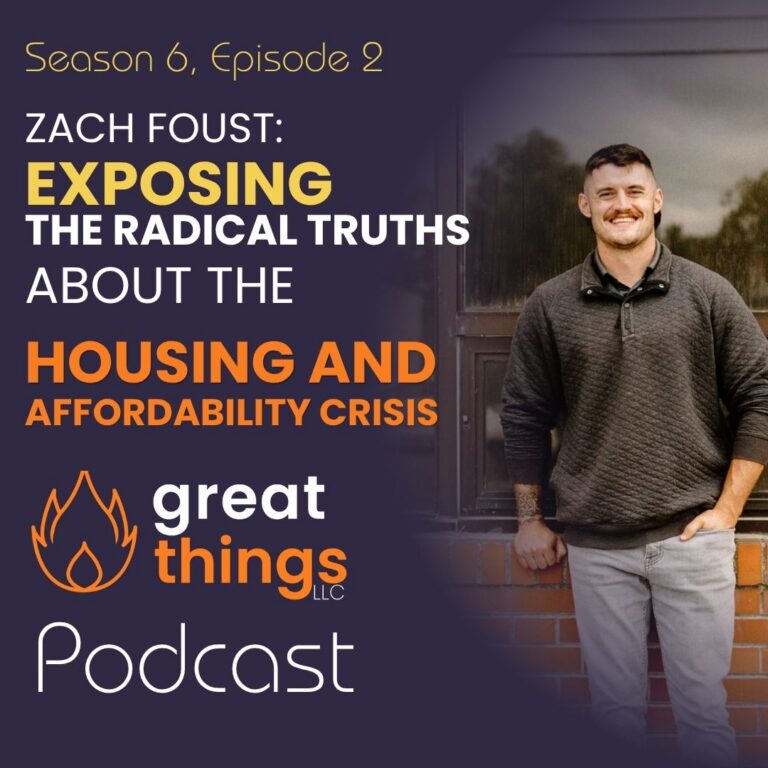

This was a podcast I have been extremely stoked to have. I found Zachary Foust about a year ago, scrolling Instagram like anybody else. I don’t know exactly what stopped my thumb, but something about the way he was breaking down the economy. No spin, no political push, just the numbers and the patterns made me forward his account straight to my son.
So when the chance came to sit down with him for the podcast, I took it. Zach’s a real estate agent out of Delaware, running the number one team in the southern part of the state for close to a decade now. He’s also an Army veteran, a former corrections officer, and somewhere along the way he became an independent economic researcher with millions of people watching him explain the Federal Reserve, the housing affordability crisis, and the Trump administration’s promises in plain English.
What I wanted to know going in: how does a guy who spent years selling homes end up becoming one of the most trusted voices on the economy that’s making it so hard to buy one?
The Crack
Every episode of this show, I’m listening for the moment. The one where the life someone built stops fitting and something else starts pulling. Zach didn’t hesitate when I asked him about his.
“The crack was realizing the life I was living was everybody else’s variation of my life. And I didn’t know who I was.”
He broke it down further. Every habitual thought, every emotional reflex, every belief he was carrying wasn’t something he chose. It came from teammates, classmates, teachers, family, religion, community. Before the internet, he pointed out, you’re really only shaped by a couple hundred people your first eighteen years. So of course you turn out like a culmination of them.
For Zach, the crack came wrapped in mortality. Somewhere in the mix of chasing more and pushing harder to prove he was enough, it hit him: he was going to die. So was everyone else. It had happened billions of times before and would happen billions of times again. So why was he giving so much of himself to things that were holding him back?
That’s not despair, by the way. That’s surrender, the recognition that the world has been turning long before us and will keep turning without our permission. And for Zach, surrender didn’t lead to giving up. It led to chasing more truth.
Losing the Lie, Finding the Work
Around that same time, Zach was digging into government and the Federal Reserve, and a second realization landed on top of the first: a lot of what he’d been sold about the economy, about the country he deployed for, about the whole patriotic package had cracks in it too.
That’s a heavy thing to sit with. But instead of retreating into cynicism, he redirected. Family first. Then self-discipline and personal development. Then education because as he put it, “when I learn, I teach. I feel one of the best ways for me to learn is to teach.”
That’s the whole shift, right there. Not a pivot away from real estate into content creation. A refusal to keep being the guy who might, at the end of it all, have just been “the middleman who helped people into houses.”
Building a Following Without a Political Angle
Zach told me something I think about a lot: the closest people to you are usually the ones most uncomfortable when you change. Not because they don’t love you, because they knew you as one version, and it’s hard to watch that version go.
He felt that discomfort firsthand. Years spent coaching other agents on how to sell, how to market, how to grow and now here he was doing the opposite in public. But what let him go all in was that he genuinely wasn’t coming at any of it from a political place. He was following patterns, history, data. His own theory, built on his own research.
That didn’t stop people from assigning him a team anyway. As he explained it, anytime you talk about something that can be politicized, people’s prior bias colors it whether you intended a color or not. He accepted that cost because the alternative, staying quiet about what he was seeing wasn’t really an option anymore.
The Numbers Behind the Crisis
This is the part of the conversation that stopped me. Zach’s early spark for all of this was standing in an open house with a couple making $150,000 a year in Delaware, watching them qualify for nothing but a townhome. That was late 2023, right as he was already telling his own real estate team to brace for a slowdown.
Here’s the stat he dropped that I haven’t stopped thinking about: you now need to make more than $105,000 a year to afford the median home in America. Six and a half years ago, that number was $46,000.
Not decades. Six and a half years.
And when I asked about solutions, Zach didn’t let either political side off the hook. Harris’s down-payment assistance plan never explained where the money would come from or how it’d get repaid. Trump promised lower mortgage rates and two million new homes, and neither has materialized. Fifty-year mortgages get floated as a fix, and all that really does is make you rent from the bank for twice as long while paying triple the interest.
His frustration wasn’t partisan. It was that nobody serious is sitting down to actually solve this for the next generation, the ones who, by the numbers, don’t believe they’ll ever own a home. And he’s right that the fixes exist. Economists have written about this for decades. We just don’t convene the conversation.
Why the Fed Comes Next
From housing, the thread pulled Zach straight into the Federal Reserve — a private entity with two mandates: stable prices and a healthy job market. His read is that, over the last seven or eight years, neither party and neither administration has done that job particularly well.
One thing that cracked his own thinking open: the Fed’s target is 2% inflation meaning prices are always designed to rise every year. So when do prices actually come back down? They largely don’t, by design.
He traced it back further, to 2008, when quantitative easing wasn’t just re-upped it was invented. Printing money to buy long-term bonds, suppressing the bond market to bring credit up cheap, stimulating the economy. It worked in the short term. The cost showed up later, in the weakened dollar and the inflation we’re all living inside of now.
The Real Takeaway
I keep coming back to Zach’s framing of his own “crack,” because it’s the same principle I talk about on this show every week: when your passions and your path align, the outside noise stops mattering, because you understand why you’re doing it.
Zach isn’t chasing a platform. He’s chasing truth, pattern by pattern, and teaching what he finds along the way. That’s a conscious business in motion, values driving the work, not the other way around.
If this conversation lit something up for you, go find Zach and follow the research yourself.
Connect with Zach: Instagram: Zachary.loft TikTok: @zacharyloft X: @Zacharyloft Facebook: zachary.foust YouTube: Zach Foust Show
Watch the full episode on YouTube, or listen on Apple Podcasts and Spotify.
